
Story
Why LPs Back Siena Instead of Another VC Fund.

Venture returns with a shorter clock, a known asset and a better entry price – and what the benchmark says about how we've done.

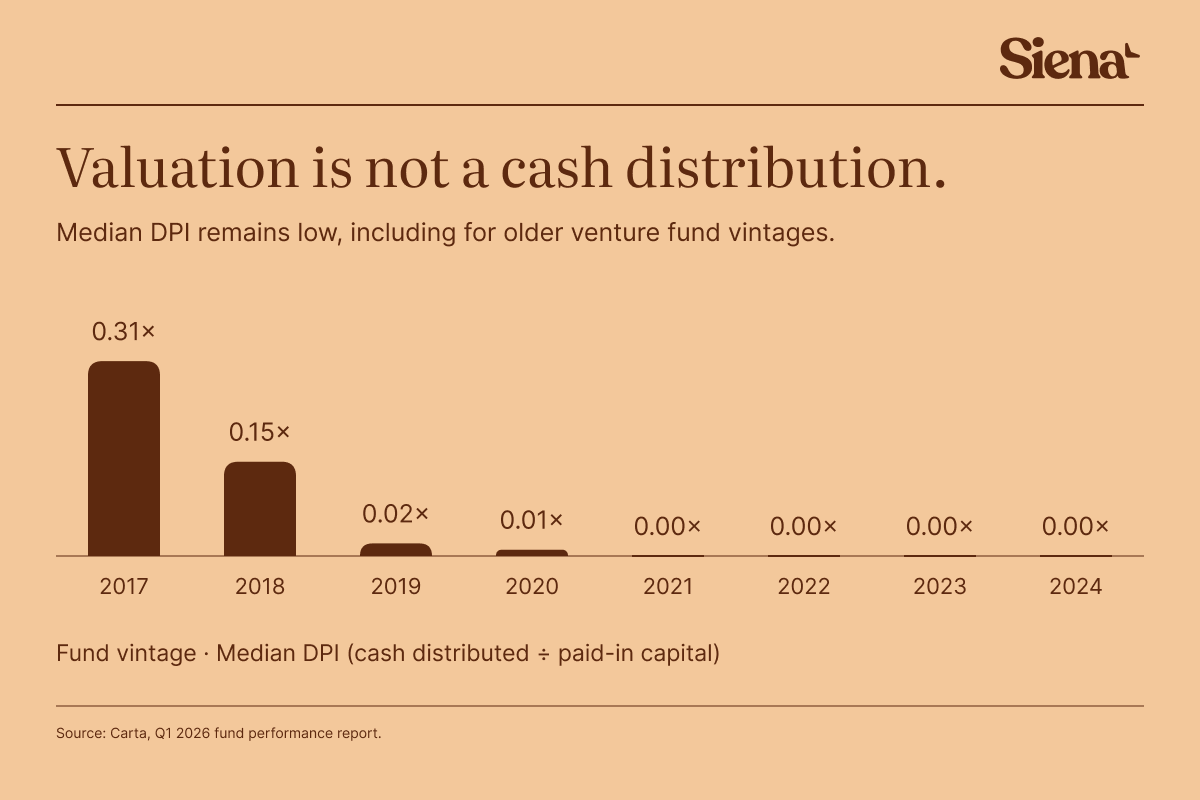
Venture's problem for an LP was never the upside. It's everything around it: a ten-year lock-up, capital called years before anything shows for it, marks nobody outside the fund can test, and distributions that arrive late or never. Carta's Q1 2026 fund benchmark puts it bluntly: the median VC fund from every vintage since 2019 has returned essentially nothing to its LPs yet, and fewer than one in five funds from even the 2017 and 2018 vintages has paid back 1x.¹
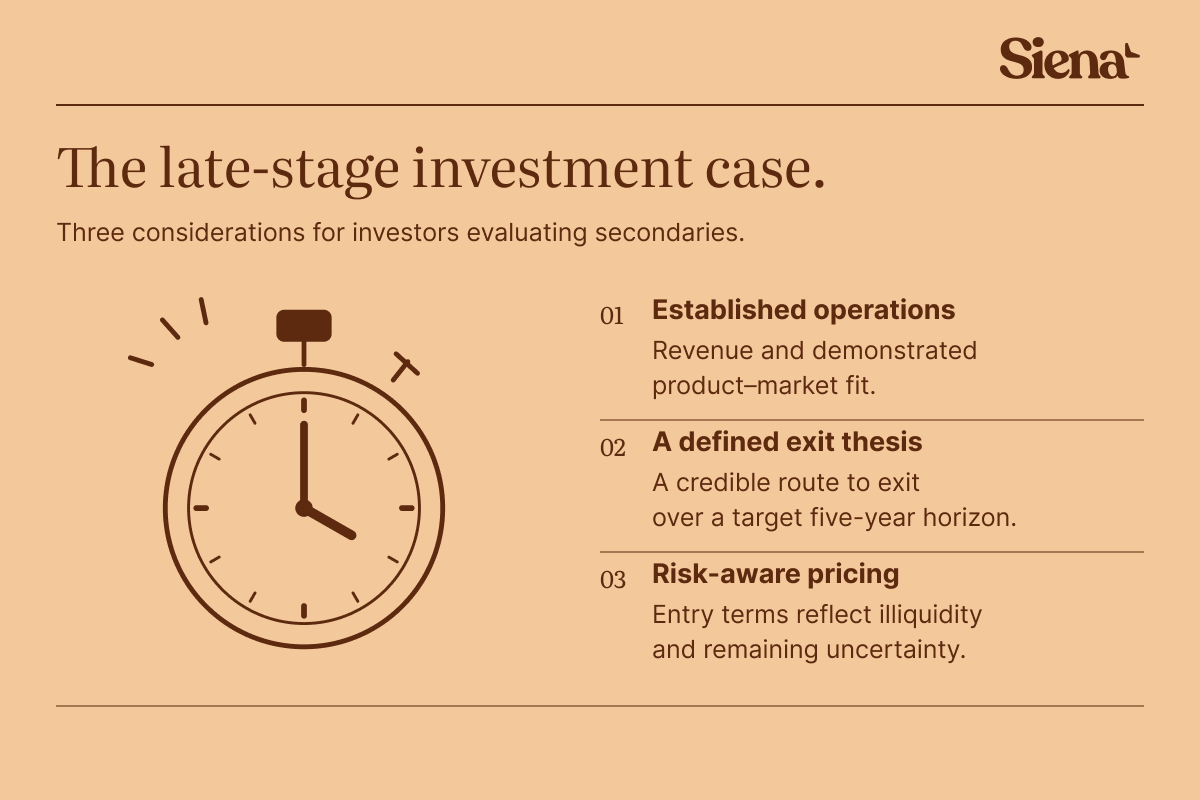
A late-stage secondary strips most of that out. We buy into companies five-plus years in, with real revenue and product-market fit already proven, at a price anchored to a priced round and adjusted for the wait. Every position is a known company with years of numbers behind it. The clock is shorter: we target exits within about five years, not ten. And the cash comes back sooner. Siena Secondary Fund’s Fund I, 2021 vintage, is already in harvest mode and has begun returning capital to our LPs. That's de-risking the venture asset class, not diluting it: the same companies, later entry, shorter hold, better price.
Does giving up the lottery ticket cost you returns? The benchmark says no. Carta's Q1 2026 data ranks every VC vintage by net TVPI. Against it, both Siena funds sit in the top decile of their peer group – Fund I against its 2021 vintage, Fund II against the 2024 cohort, the youngest Carta reports and a year older than Fund II itself.²
That's the thesis: venture-grade returns from companies that had already proven themselves when we bought in, at a price that already reflected the wait. And Fund I is already turning paper into cash – something the median fund of its age, per Carta, has yet to do.
The other thing an LP buys from us is the door. Our first-ever deal, in 2018, was a secondary in Bolt – likely the first secondary transaction the company had ever done. Positions like that come from a decade inside the Estonian and wider CEE ecosystem – founders, early employees, angels, and boards that grant a waiver because they know who's asking. Most of our deal flow comes straight from founders and employees, not from brokers or auctions. That's the asset an LP can't buy elsewhere: not the companies – the entry.
The people who checked this hardest are already in. Fund II's LPs include the European Bank for Reconstruction and Development (EBRD), SmartCap – Estonia's state-owned fund manager – Luminor Pensions Estonia and Isomer Capital, alongside family offices and founders from across the Baltics and Nordics. A development bank, a state fund, a pension fund and a fund-of-funds don't back a small Estonian manager on a story. They back it after diligence on the track record, the process and the governance. For an allocator, that work has been done once already, by institutions whose job is to be hard to convince.
If you're an allocator who wants venture exposure without the ten-year wait, or an LP working out how we stack up against the venture funds already in your book – that's the case. The full numbers sit in the data room. The argument doesn't change once you're in it.
1. Carta, "VC Fund Performance: Q1 2026" (data as of Q1 2026). https://carta.com/data/vc-fund-performance-q1-2026-full-report/ – net figures across Carta-administered funds; US-weighted.
2. Net TVPI vs Carta's 90th percentile for the 2021 vintage (1.54x) and 90th for the 2024 vintage (1.35x).