
Story
Why CEE and the Nordics Are Producing More Secondary Supply Than Ever.
The funding math behind a growing pool of shares looking for a buyer.
Two numbers tell most of the story. Across the wider secondary market, activity has gone from roughly $50 billion in annualised transaction value in late 2024 to $97.6 billion by the first quarter of 2026 – nearly doubling in about fifteen months, and enough for secondaries to overtake public offerings as a source of venture liquidity for the first time.¹ That's a global, US-weighted figure driven disproportionately by a handful of very large private companies, so it isn't a CEE number. But it's the backdrop against which CEE's own dynamics are playing out, and the direction is what matters.
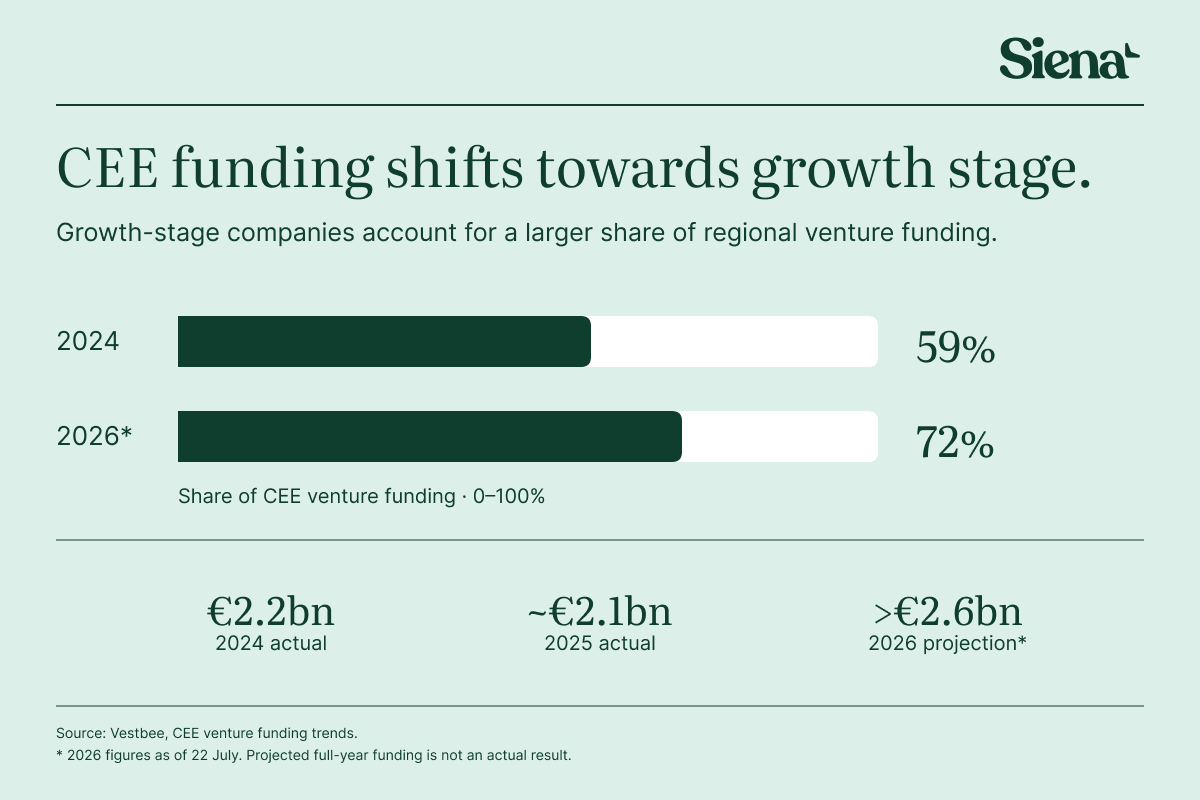
Closer to home, the picture in CEE is one of concentration. Total funding into the region has held in a fairly narrow band – €2.2 billion in 2024, roughly €2.1 billion in 2025, on pace for something above €2.6 billion in 2026 – but the composition underneath has shifted hard toward later stages.² Growth-stage rounds had captured 72% of all 2026 capital as of 22 July, up from 59% just two years earlier, even as early-stage deals still make up the overwhelming majority of transaction count. Pre-seed deal volume alone is tracking more than 50% below 2025 levels. Put simply: fewer new companies are being funded into existence, and the capital that is flowing is concentrating into a smaller number of companies that are older, larger, and further along.
That's exactly the setup that produces secondary supply. The 2018-2022 funding cycle put a large number of CEE companies through Series B and C rounds at valuations that, in several cases, still haven't been re-tested by a subsequent primary round. Those companies are now five-plus years old. Old enough that early employees' options have vested and, in many cases, are approaching expiry. Old enough that the seed and Series A funds that backed them are well into the back half of their fund lives and need distributions, not just markups. And old enough that founders themselves are looking to diversify a chunk of their net worth that exists only on paper. None of that requires the company to do anything. It just requires someone willing to buy what they already own.
The exit environment isn't doing the work for anyone. IPO windows for venture-backed companies have stayed narrow and selective, and strategic M&A absorbs some but not all of the supply – which is precisely why the secondary market exists. Where a company has already proven the business works, the question isn't "will this ever be worth something," it's "who's willing to hold the paper for the years between now and the eventual exit, at a price that reflects the wait."
Supply is only half of the story – the other half is who's actually there to buy it. In the US, secondary liquidity runs through an established infrastructure: dedicated secondary funds, broker-dealers, and marketplaces that actively source, price, and clear these stakes.
In CEE and the Nordics – and in Europe more broadly – that infrastructure barely exists. There's no comparable bench of brokers or platforms competing to place the same block of shares.
For a seller, that's a gap. For a buyer willing to do the sourcing and pricing work directly, it's the advantage: less competition for the same supply, in a market that hasn't been arbitraged away the way the US one has.
That's the gap Siena Secondary Fund exists to fill in CEE and the Nordics. We're built for exactly this kind of situation – long-vintage cap tables, shareholders who've waited long enough, and a wait that carries a real cost even when nobody says so out loud. We don't pretend that cost isn't there. We just deal with it.
1. Crowdfund Insider, "US Venture Capital Secondary Market Surges To Record Levels In Early 2026" (May 2026). https://www.crowdfundinsider.com/2026/05/278123-us-venture-capital-secondary-market-surges-to-record-levels-in-early-2026-research/
2. Vestbee, "How CEE venture funding is changing in 2026" (22 July 2026). https://www.vestbee.com/insights/articles/cee-venture-funding-trends