Story
What Is a Late-Stage VC Secondary?
A plain-language guide for founders, early employees, and funds that already own the shares.
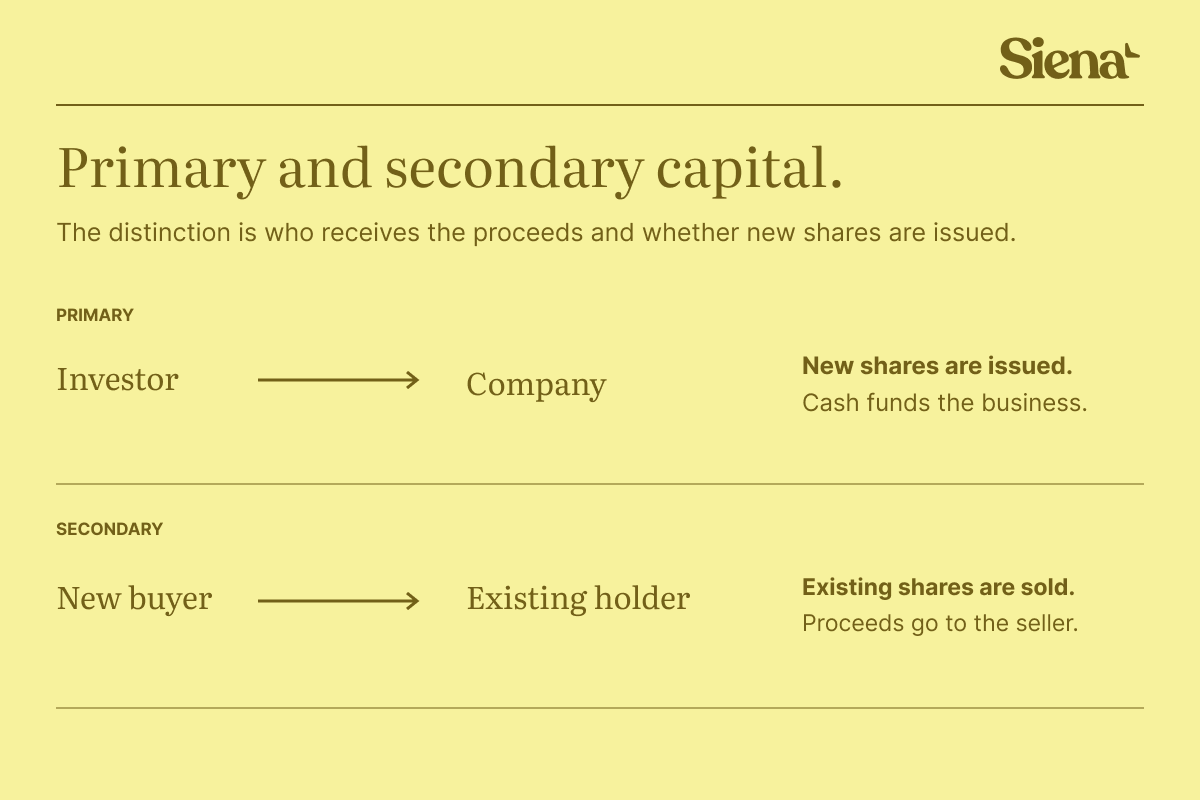
Every funding round you've heard of – seed, Series A, Series B – is a primary transaction: new money goes into the company, and the company issues new shares in return. A secondary is the complementary move. No new money reaches the company, but an existing shareholder – a founder, an early employee with vested options, an early investor, or a fund nearing the end of its life – sells shares they already hold to someone new. The company's balance sheet doesn't move – the cap table does.
Late-stage specifically means this happens years in, once the company has real revenue and has proven its product in the market. But there has rarely been a liquidity event. That's the whole reason the market exists. A company that raised a Series B in 2019 and is still private in 2026 has employees sitting on paper wealth they can't spend, and early funds sitting on positions they need to return capital on. Both want to get out, or to realise some of their gains. Neither may want to wait for an IPO that may be years out.
Why now, specifically: 2018-2022 was an unusually large funding cycle in the private markets. A lot of companies raised big rounds at high valuations and are now five, six, seven years past that raise – old enough that options may be expiring, and old enough that the seed and Series A funds behind them are hitting the back half of their fund life and need to show LPs distributions, not just markups. None of that requires the company to sell or IPO. It just requires someone willing to buy what already exists.
That's where Siena Secondary Fund comes in. We are exactly the buyer for these shares, and we only take positions where the business itself earns it: proven product-market fit, real revenue, a plausible path to exit within about five years. We take minority stakes in plain-vanilla transactions: typically under 5% of the cap table, with check sizes usually €1-5M. That makes us the go-to partner for a simple liquidity unlock.
This isn't abstract for us. Our first-ever deal, back in 2018, was a secondary in Bolt – likely the first secondary transaction the Estonian ride-hailing company ever did. That's the deal that convinced us there was a real, systematic opportunity, not just a one-off.
This isn't abstract for us. Our first-ever deal, back in 2018, was a secondary in Bolt – likely the first secondary transaction the Estonian ride-hailing company ever did. That's the deal that convinced us there was a real, systematic opportunity, not just a one-off.
Geographically, we're anchored in CEE and the Nordics – not necessarily by where a company is incorporated (a Delaware HoldCo is completely normal here) but by where the engineering and operations actually sit. Estonia, Finland, Poland, Romania, the Baltics, elsewhere in CEE or the Nordics – that's in scope. It's the footprint behind many names already in our portfolio.
If you're a founder, an early employee with a chunk of vested options and no liquidity event on the horizon, or a fund manager watching a portfolio company age past your intended hold period – that's the conversation to have with us. Not "should we sell the company." Just: how can I realise some of those gains? Reach out and let’s have a chat about your options, confidentially, no strings attached.