Story
How Siena Actually Evaluates a Secondary.

What happens between "someone wants to sell shares" and a signed deal.

Most of what gets written about VC funding describes the primary process – pitch, term sheet, close. Secondaries work differently, and at Siena Secondary Fund the differences are mostly about discretion, pace, and who's actually driving the conversation.
A secondary doesn't always start with a company raising a round. It often starts with a specific shareholder – a founder, an early employee, an early investor, or a fund nearing the end of its life – who wants to realise some of what they've built. We're usually introduced through the company, an existing investor, or someone we've worked with before, and we move at the pace the situation actually needs rather than the pace a formal process would otherwise set.
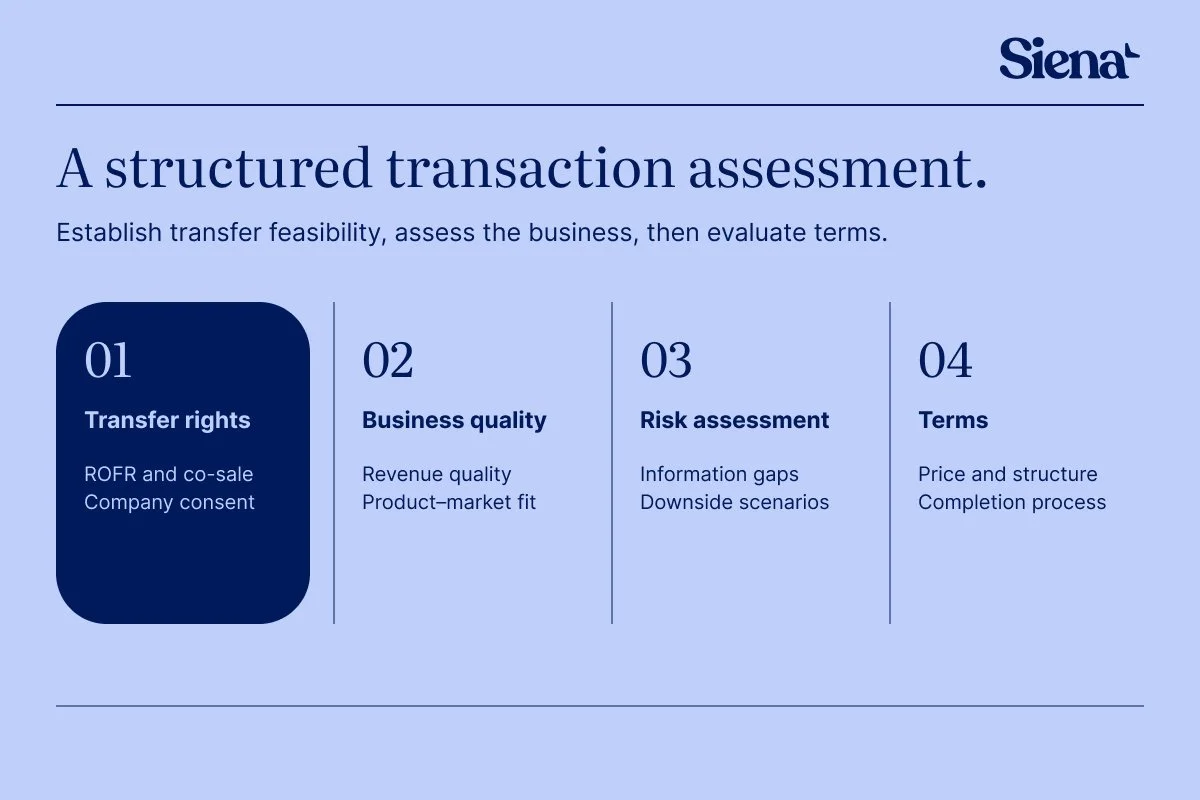
Before we talk price, there's a gate every deal has to clear first: are we actually allowed to buy what's on offer? That means checking ROFR and co-sale rights on the cap table before anything else moves – more than one promising conversation has stalled there, and it's better to find out in week one than after terms are agreed. Past that gate, we do the rest of the work – understanding the business and whatever else stands between an interested buyer and a completed transaction. Where the information is readily available, that's straightforward. Where it isn't, we go find it ourselves rather than treat the gap as someone else's problem.
We're disciplined about what we take on. Not every situation is one we can help with, and we'd rather say so early than waste anyone's time getting to a "no" later in the process.
If you're a seller weighing whether to run this process, a co-investor exploring whether to work together, or an LP curious what actually happens once a conversation starts – that's the shape of it. The specifics depend on the deal. The discretion and the discipline don't.